The Story of Education in Wabush and Labrador City
Education in Labrador West grew from the same forces that shaped the towns themselves: isolation, ambition, and a determination to build a full and complete community in a place where, only a few years before, the caribou outnumbered people. From bunkhouses to modern facilities, the story of education in Wabush and Labrador City is one of adaptation, cooperation, and eventually independence.
While mining companies built the first houses, schools built the first sense of home for the families who arrived in the 1960s. Over time, the education system transformed from a patchwork of religious traditions into a fully unified, modern school district. What began as frontier-style classrooms now stands as one of Labrador’s most distinctive cultural legacies.
School segregation in Labrador West wasn’t based on race, but on religion. Until 1997, Newfoundland and Labrador operated under a unique Denominational Education System protected by the Canadian Constitution. Schools were not “public” in the modern sense; they were run by churches (Catholic & Anglican, United, Salvation Army, Pentecostal) but funded by the government.
In the planned mining towns of Labrador City and Wabush, this system collided with the industrial desire for efficiency, creating two very different realities.
The history of education in Labrador City is a reflection of the province’s history: a tale of two distinct solitudes, divided by faith but united by geography. For nearly forty years, the children of the iron ore miners were sorted not just by age, but by denomination. In the subarctic isolation of Labrador West, where community was everything, the school you attended defined your social circle, your sports team, and your identity.
The Great Divide: The Denominational Era (1960s–1997)
From the town’s incorporation until the educational reforms of 1997, Labrador City operated under a “dual system.” On one side stood the Roman Catholic School Board, serving the town’s large population of Irish descendants and Francophone families. On the other stood the Integrated School Board, serving the Protestant denominations (Anglican, United, Salvation Army).
For a child growing up in Lab City during this era, the path was predetermined.
The Integrated Stream
The Protestant system was characterized by its expansive facilities and close ties to the mining management hierarchy.
The journey began at C.E. McManus School. Named after Charles E. McManus, a titan of the Iron Ore Company of Canada (IOC), this facility served as the primary school (Kindergarten to Grade 3). It was the nursery of the Integrated system, where the children of engineers and miners first learned to read.
From there, students graduated to A.P. Low School. Named for the geologist Albert Peter Low, who first mapped the Labrador Trough, this school handled the elementary and middle years (Grades 4–7). It was the bridge between childhood and adolescence, preparing students for the Big School across town.
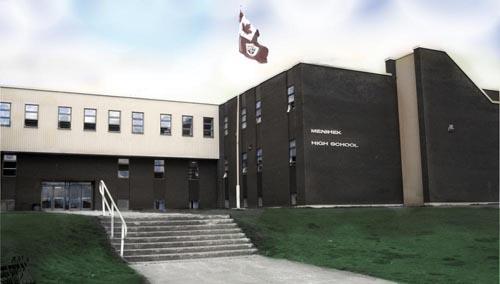
The summit of the Integrated stream was Menihek High School. Opened in the early 1960s, Menihek was designed to be the flagship. It was large, modern, and imposing. Its gymnasium was a cavernous space, large enough to be divided by a curtain, giving it the feel of a collegiate arena. It was here that the “Menihek Magic” was born—a culture of excellence, particularly in drama and basketball, that prided itself on the quality of its facilities and the size of its student body.
The Catholic Stream
Running parallel to this was the Catholic system, which often prided itself on grit and a tightly knit community spirit.
The foundation was Notre Dame Academy, located near the Basilica of Our Lady of Perpetual Help. For decades, this school (initially staffed by the Presentation Sisters) provided elementary education to the Catholic youth. It was a place where faith and education were deeply intertwined.
The heart and soul of this stream, however, was Labrador City Collegiate (LCC). Located at 200 Campbell Avenue, LCC was the high school for the Catholic teenagers. If Menihek was the giant, LCC was the scrappy underdog. The school developed a fierce identity around its sports teams, known as “The Express.”
LCC was defined by its gymnasium, affectionately and notoriously known as “The Crackerbox.” It was incredibly small. The sidelines were so narrow that spectators sitting in the bleachers could reach out and touch the players. When the gym was packed for a Friday night game, the noise was deafening, creating a claustrophobic and intimidating atmosphere that gave the “Express” a distinct home-court advantage.
The Rivalry: Magic, Express, Thunder
Throughout the 1970s, 80s, and 90s, the rivalry between Menihek, LCC, and JRSC was the centerpiece of teenage life in Labrador West. The three High Schools fought every year to be the School that represented Labrador West at the Provinical Championships in both boys and girls Basketball, VolleyBall and Soccer.
The Wabush Experiment
While Labrador City’s youth were locked in the rivalry of the “Two Solitudes,” a different story was unfolding in the neighboring town of Wabush. Here, necessity—and the pragmatism of the mining company—birthed a unique educational experiment that was decades ahead of its time. Wabush Mines, having observed the duplication of services elsewhere, refused to bankroll two separate high schools for such a small population. The result of this forced compromise was J.R. Smallwood Collegiate.
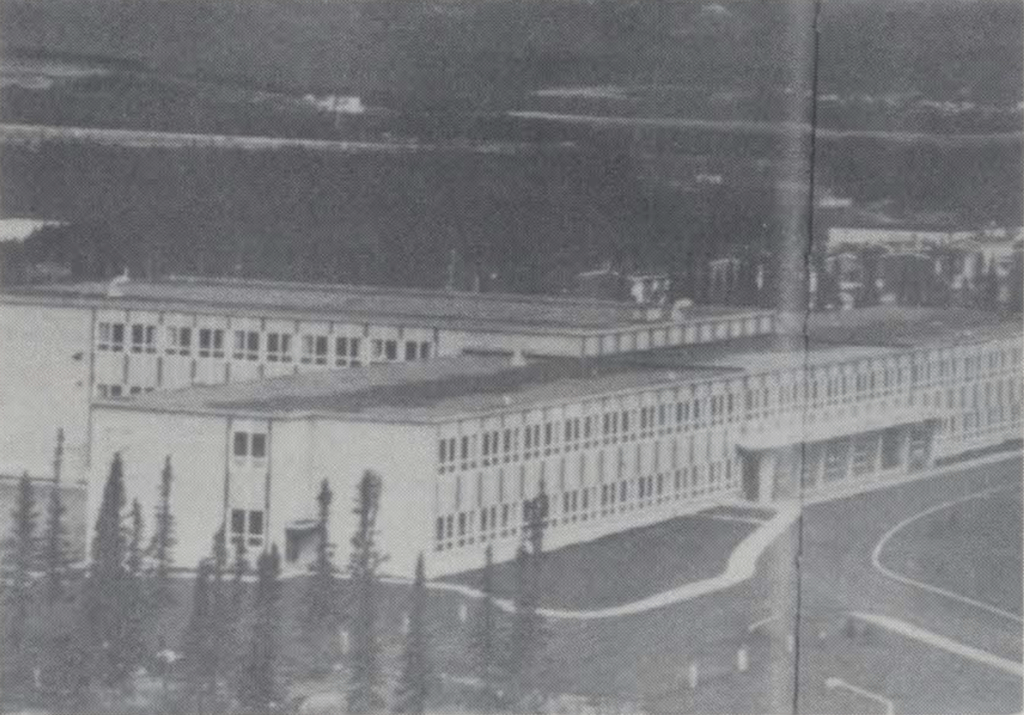
Opened in 1963, the school was built as a “Joint Service” facility, an architectural admission that the two sides would eventually have to meet in the middle. The building was physically constructed with two distinct wings: the “Catholic Wing” (Sacred Heart), run by the Catholic School Board, and the “Integrated Wing,” run by the Protestant board. Connecting these two halves was a shared “demilitarized zone” containing the expensive facilities that neither board could afford alone: the gymnasium, the library, and the science labs.
The daily ritual was a physical manifestation of the compromise. Students would enter through the same main doors every morning, only to turn left or right depending on their religion. In the early years, the separation was strict, with classes like History and Religion taught in isolation, though they might mix for Gym. But practical necessity soon chipped away at the walls. By the 1990s, it became inefficient to teach “Catholic Math” and “Protestant Math” to smaller classrooms, leading to the integration of most academic subjects. This forced proximity meant that the youth of Wabush grew up with a level of social integration unknown in other Newfoundland towns, where Catholics and Protestants might never truly mix until adulthood.
A Unified Legacy
Today, the fierce rivalry of the “Two Solitudes” exists only in the memories of the alumni. A student attending Menihek High today walks halls that belong to the entire community. They may live in an apartment in the old LCC building, or have attended kindergarten in the old Integrated school, but they graduate together. The “Magic” remains, but it is no longer defined by who it excludes—it is now the singular spirit of Labrador City’s youth.
This segregation ended in 1997 after two provincial referendums. The government seized control of the schools from the churches to create a single, secular public system.
Teaching in a Fishbowl
To work as a teacher in Labrador West before the Great Reformation of 1997 meant signing over more than just your working hours; you signed over your conscience. Teachers were not employees of the government, but of the specific Denominational Boards—Catholic or Integrated. Consequently, you weren’t just hired for your pedagogical ability. You were hired for your soul.
Contracts in the mining towns came with strict, legally binding “morality clauses.” The expectation was that a teacher must be a “bona fide” member of their denomination—a protection baked into the 1949 Terms of Union with Canada. In practice, this meant a Catholic teacher could be terminated for conduct “unbecoming of a Catholic,” while a Pentecostal teacher could be fired for smoking a cigarette or drinking a beer, even within the privacy of their own home.
Life Under the Microscope
In a metropolis like St. John’s, a teacher might manage to slip into the anonymity of the city after the bell rang. In the isolation of Labrador West, anonymity was a luxury that did not exist. The “fishbowl effect” of the company town was absolute.
The enforcement mechanism was local and immediate. The same priest or minister who sat on the School Board and authorized your paycheque also looked out from the pulpit on Sunday morning. Church attendance was effectively mandatory; a teacher who skipped Mass for a few weekends to ski at Smokey Mountain might find themselves pulled aside on Monday morning for a “quiet word” regarding the security of their tenure.
The scrutiny extended into the night. The Ashuanipi Social Club (The “Ash”) was the center of gravity for local nightlife, but for teachers, it was a minefield. A teacher seen drinking too heavily or dancing “inappropriately” on a Saturday night could expect a report to be filed with the Board by Monday.
The “Thou Shalt Nots”
The morality clauses turned personal life choices into fireable offenses. The rules created a climate of fear that dictated the most intimate aspects of a teacher’s life:
- Interfaith Marriage: This was the most common trap. A Catholic teacher wishing to marry a divorced Protestant—or simply a non-Catholic—often faced an ultimatum: your fiancé or your career.
- Divorce: In the Catholic system, filing for divorce was often grounds for immediate dismissal or, at the very least, a permanent block on promotion to administration.
- Pregnancy: For female teachers, an out-of-wedlock pregnancy was an automatic termination. There were instances in the province where women were forced to resign the moment they began to “show,” to avoid “scandalizing” the student body.
- Common Law: Despite the severe housing shortage in Labrador City, living with a partner before marriage was strictly forbidden.
The Cold War at J.R. Smallwood
Nowhere was this theological tightrope more absurd than in the hallways of J.R. Smallwood Collegiate in Wabush. Because the school operated with two distinct wings, it effectively housed two separate staffs under one roof, governing the same students with vastly different rules.
It created a bizarre “Cold War” atmosphere in the staff room. A teacher in the “Integrated Wing” (Protestant) might survive a divorce with their job intact, while their colleague in the “Catholic Wing”—teaching the exact same subject just thirty feet down the hall—would be fired for the same action. Tensions often simmered, with the “liberal” habits of the Integrated teachers (relaxed dress codes or smoking) viewed with deep suspicion by the religious orders that still held sway over the Catholic wing.
The Collapse of the Clergy’s Control
The pressure on teachers became a primary engine for the reform movement of the 1990s. following the Mount Cashel scandal, which shattered the public’s trust in the church’s ability to manage the welfare of children, the teachers’ union (NLTA) became a fierce advocate for a secular system. They demanded to be judged on their competence, not their adherence to dogma.
When the denominational system was finally dissolved in 1997, the “morality clauses” were rendered illegal. For the first time in the history of Labrador West, teachers could live with their partners, skip church, and teach without fear of the Monday morning report.
Leave a Reply